
 Accessible winter atmosphere in Østerdalen and at RørosViser Vingelen på vinteren
Accessible winter atmosphere in Østerdalen and at Røros
For many, National Road 3 is primarily a transit route between Oslo and Trondheim. But between Rena in the south and Haltdalen in the north lies a region that deserves far more than to simply be passed through.
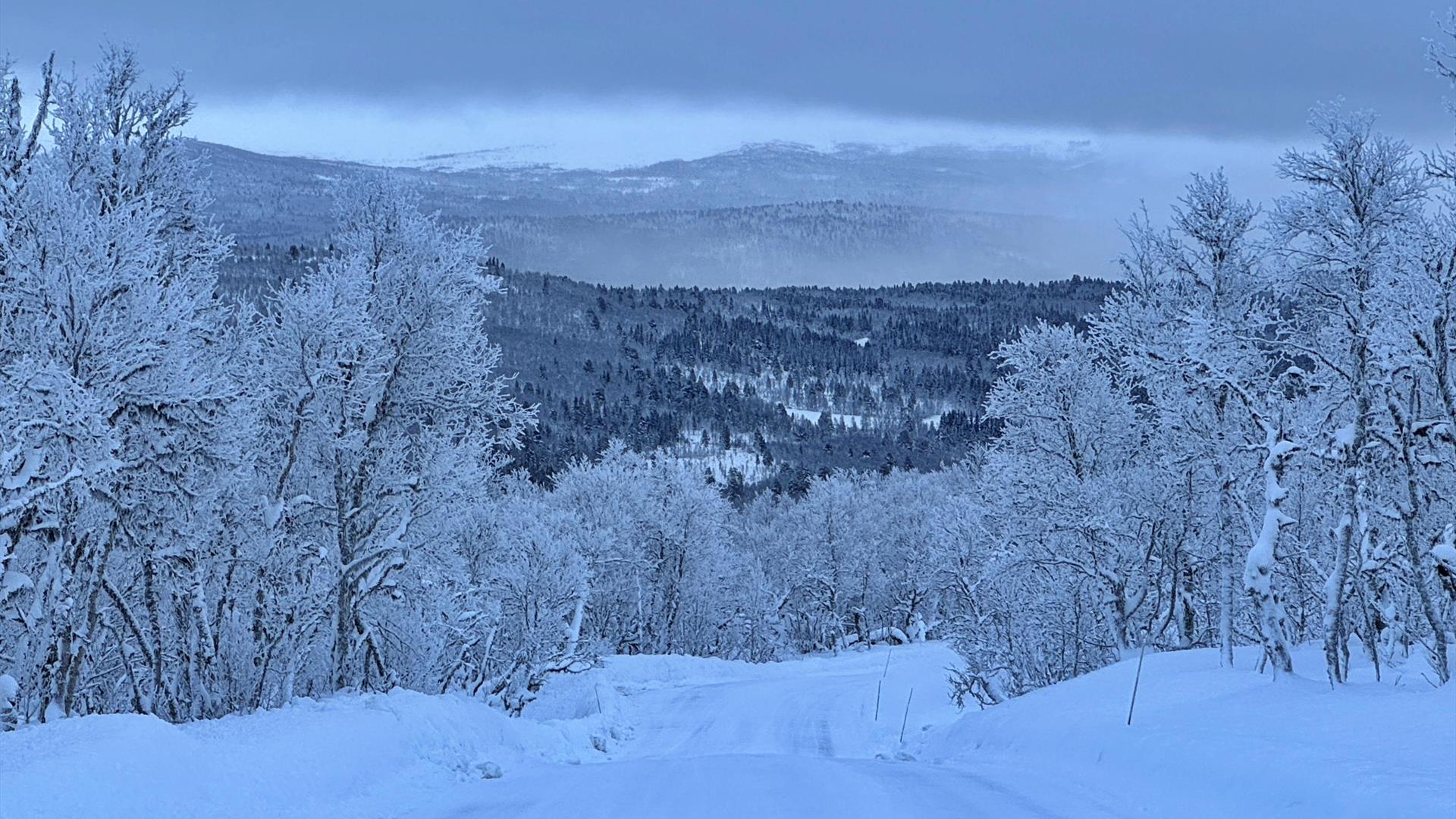
Here, winter reveals itself at its very best. Snow settles like a sparkling blanket across the landscape, trees are wrapped in white, and tiny snow crystals catch the light when the sun hangs low in the sky. Sunrise and sunset cast a colourful veil across the landscape, and when darkness falls, the night sky becomes clear and vivid.
Along this stretch, towns and winter experiences are lined up for those who enjoy spending time outdoors in the fresh air. When the thermometer drops well below freezing and the cold nips at your nose, the dry air means that the chill rarely feels as harsh as the numbers suggest. The snow creates a muted soundscape, while the clear winter cold produces the familiar creaking sound associated with the season.
Having spent a lifetime on crutches, I know how important it is to understand a place before travelling. To know what works, and what requires a little extra effort. Whether you use a wheelchair, walk with crutches, have other mobility challenges or are travelling with a pram, it is precisely these concrete details that make it easier to relax and actually set out on your journey.
So, during a four-day road trip in January, I took the time to explore Østerdalen and Røros at a slower pace. Through a landscape abundant with snow, quiet forests, charming villages and welcoming hotels, I experienced a region that invites you to leave the main road and stay a little longer. It brings a particular sense of calm and makes it easy to understand why so many people seek out this part of the country in winter.
Day 1: Inland nature and culture

Rena in Åmot municipality is a natural place to begin the journey when arriving from Oslo. The municipality offers a varied selection of nature-based experiences, and in winter there is easy access to both alpine ski resorts and cross-country trails. Rena is known as the starting point for the Birkebeinerrennet race, which continues all the way to Lillehammer. Birkenåsen, located at the start of the race, is considered snow-reliable and is a popular ski area with several trails of varying lengths and levels of difficulty.
During my visit, I stopped in the town centre to see the cosy shopping street and the impressive Åmot Church, also known as the Timber Cathedral. The church is built of notched timber in Art Nouveau style and was designed by the architect Henrik Bull.
The journey then continued north towards Koppang in Stor-Elvdal municipality. Here, you may continue along National Road 3 or choose the more scenic County Road 606 through the landscape along the Glomma river, with forest and mountains on both sides. The area has attracted both artists and writers throughout history, and it is easy to understand why Bjørnstjerne Bjørnson described the area as Norway’s own Rhine Valley.
Along the way, I passed Stai Station, a small, unmanned station building designed by the architect Georg Andreas Bull and now protected by the Norwegian Directorate for Cultural Heritage.
In Koppang stands Stor-Elvdal Church, a fine octagonal wooden church from the 19th century that likely served as inspiration for the design of Tolga Church, designed by Rasmus Svendsen Aspås.
Bjørnstjerne Bjørnson often stayed here and formed close ties with the local population. He later donated a significant book collection to the municipality, today known as the Bjørnson Library.
Here, history and accommodation can be combined with a visit to Stor-Elvdal Hotel, a cosy and historic hotel with good accessible solutions. Behind the main building lies a courtyard with protected houses, a museum and a pub. The museum contains an extensive collection of Norwegian artworks, cultural objects and historical artefacts from several centuries.
In the main building there are ramps, automatic doors and a very well adapted bedroom. Other rooms in the main building have bathrooms with a high threshold and a somewhat narrower layout. The parking area is located around sixty metres from the entrance, and all meals are served in a spacious restaurant with large windows facing the courtyard. Traditional food is prepared from scratch here, and the elk burger was a highlight.
The courtyard has a solid surface and a ramp leading into the pub, while the museum has a high stone staircase at the entrance. Inside, there are several chairs in each room, making it possible to take breaks along the way. The pub has some challenging thresholds, and only the women’s toilet is accessible for wheelchair users.
Some of the courtyard’s buildings have bedrooms but require steps to enter, and some rooms are located on the second floor without a lift. The hotel also has a newer building from 2021 on the other side of the road, with step-free access, a lift, door openers and parking located close to the entrance.
After lunch I continued towards Alvdal, the home village of the multidisciplinary artist Kjell Aukrust, one of the region’s most beloved cultural figures and the creator of the well-known Flåklypa universe.
The village lies in an open position in the Glåma valley, with Tronfjellet as a distinct landmark on the horizon. The centre, commonly referred to as Steia, is compact and easy to navigate, with shops and services gathered in one place.
In and around the village, there are several places of interest. Husantunet, one of the country’s best preserved farmsteads, offers insight into historical farming practices, while Aukrust Centre presents both the literary works and illustrations of Kjell Aukrust. Nearby is also Jutulhogget, one of the largest canyons in Northern Europe.
In winter, however, skiing sets the tone in Alvdal, a community with strong skiing traditions. One of the oldest wooden skis found in Norway originates from here, which is also reflected in the municipal coat of arms, and an extensive network of trails is prepared throughout the season.
Ten minutes outside the centre lies Finnbudalen, where I headed out onto a cross-country ski trail with gentle terrain suitable for all levels. The trail starts approximately ten metres from the parking area and offers around nine hundred metres of flat terrain before a gradual incline of approximately five hundred metres.
The trail is known as a favourite among older skiers, with minimal elevation and no need for a herringbone technique. Alternatively, you may start from the opposite end to avoid the incline entirely. Along the way, the forest opens up with fine views towards mountains and valleys.
Another good option in the area is a four-kilometre trail around Lomsjøen, approximately twenty minutes from the centre, with gently undulating terrain through a cabin area popular among families with young children.
I concluded the day at Frich’s Hotel and Spiseri in Alvdal, a practical and easily accessible place to stay with parking directly outside the entrance, as well as a ramp and door openers.
Please note that the adapted rooms are located approximately one hundred metres from the reception, and that meals are served in a self-service cafeteria.
The waffles alone are worth a stop
Day 2: Charming villages and mountain terrain
The next morning I travelled on to Tynset, a town with a compact and charming centre characterised by colourful wooden houses and small shops. Tynset is often referred to as the capital of the kick sled, and in winter the sleds are parked everywhere. In the middle of the town centre you will also find the “Storsparken”, measuring over eleven metres, which has become a small landmark in its own right.
Tynset Rural Museum, the Røstvangen mines and Kvikne Church are well-known attractions that give the area a distinct sense of local traditions.
At the same time, nature is close by, and the area functions as a gateway to Forollhogna National Park. Snow-rich winters and a well-prepared trail network ensure that the skiing season lasts a long time. Before continuing, I stopped by Waagans Bakery in the town centre, known for its own Tynset-snurr – a generous cinnamon roll with vanilla cream, cream cheese and chocolate topping. This is a charming bakery, but please note that the toilets are located in the basement and can only be accessed via stairs.
The journey then continued to Tolga, a historic mountain village with beautiful wooden houses and a peaceful atmosphere. Tolga is particularly known as an agricultural municipality with strong food traditions, characterised by dairies and local food production. In the middle of the town centre lies Dølmotunet, a museum farmstead that is filled with activities, people and animals throughout the summer season.
In winter, however, skiing takes centre stage. Just outside the town centre, on the western side of the Glomma river, lies Hamran ski jumping and ski play centre, and around fifteen kilometres away lies Vingelen, with stable winter conditions and an extensive network of trails. Here I headed up into the mountains for cross-country skiing in open mountain terrain and true winter atmosphere.
The ski hut at Vingelen is a good starting point, and the Grønvola–Sæterås trail, with Hundsjøtjønna on the left-hand side, offers the gentlest terrain. On the way up, I also made a short stop at Tolga Church, a fine notched octagonal church with beautiful views over the village.
Later in the day I visited Røros Alpinsenter Hummelfjell in Os, around fifteen minutes north of Tolga and just south of Røros. Os is the northernmost municipality in Innlandet and lies at the foot of Håmmålsfjellet in a landscape characterised by gentle valleys and mountains. The area is known for its active mountain farming and functions as a natural gateway to Forollhogna National Park, with good opportunities for outdoor activities all year round.
In Os you will also find Oddentunet, a well-preserved farmstead with interiors and decorations from the early 19th century that provide a fine insight into local building traditions and rural life.
In winter, however, it is the snow that draws many visitors here, and Røros Alpinsenter Hummelfjell is a very family-friendly facility. The parking area is located only a few metres from the slope, and it is possible to put on your skis by the car and glide towards the lift. The facility includes both a children’s slope with a platter lift and a main slope with a T-bar lift, offering good conditions for both beginners and more experienced alpine skiers.
I stayed overnight at Røste Hyttetun & Camping in Os, a charming and well adapted place to stay. Three of the cabins are particularly suitable for wheelchair users, with ample space, ramps and adapted bathrooms. It is important to note that check-in takes place via an office with a step, and that the kitchen fittings in the cabins follow standard height.
As these are self-catering cabins, it felt like a luxury that the hosts make it possible to order breakfast delivered to the door in a basket. Their website stands out by showing several images of the rooms, making it easier to assess whether the cabins meet individual needs.
Day 3 and 4: Røros and winter adventures
The next morning I drove on to Røros, where I started the day with dog sledding at Kennel Dølanvollen, ten minutes north of the town centre. Here, the mountain landscape opens up, bringing you close to both affectionate dogs and a magical winter atmosphere.
The experience began with changing into winter suits before continuing to the dog yard. Both the indoor areas and the outdoor space had ramps, low thresholds and hard-packed surfaces, while the threshold into the changing room was somewhat higher than normal.
Twenty-nine huskies waited quietly and eagerly, without barking, which created a calm and pleasant atmosphere. The dogs were friendly and mainly interested in attention when they were released a couple at a time, which made it safe and easy to get to know them.
If you only wish to be a passenger, this must be communicated in advance. Assistance with harnessing the dogs is expected if possible and was experienced as relatively easy, as the dogs stood still and cooperatively lifted their legs while the harnesses were fastened.
The actual driving requires good balance and strength, with braking controlled by using your legs. The sledges are more flexible than traditional models, which places greater demands on stability. Some sections had uneven surfaces, and on uphill stretches you must expect to assist the dogs by pushing.
The sledge had a backrest and side handles, and the pace felt controlled and safe. Dølanvollen also offers five-point harnesses for those who need additional support or have difficulty sitting upright.
The tour went across open mountain plateaus high in the mountains, with wide views in all directions as the sledge was steadily pulled forward by eager dogs. The only sounds I could hear were the runners against the snow and the breathing of the dog team ahead. The tour lasted just over one hour, with several short breaks along the way.
I then drove into the town centre. The mining town of Røros is one of Europe’s oldest wooden towns and among the few former mining towns in the world to have been included on the UNESCO World Heritage List. The town developed following the discovery of copper ore in the mountains in 1644, and just two years later the first smelter was completed at Malmplassen. Around the copper works, a community developed that became a natural centre for the region, and the history of Røros Copper Works still lives on through Røros Museum, in the literature of Johan Falkberget, and in the well-preserved townscape that characterises the town today.
For those arriving by car, there is ample parking available, including several accessible parking spaces, for example directly outside Røros Church, making the area relatively easy to navigate. The town centre is compact and easy to get an overview of, and it almost feels like moving through a living museum, with beautiful wooden buildings, historical details and countless photographic motifs.
The streets were well cleared of snow, but the town has several inclines that may make accessibility more challenging for some. The main street starts at the top of the church and slopes steadily down towards the rear of Bergstadens Hotel, which may be useful to take into account when planning.
Because Røros is a listed town, many shops are only accessible via steps, but it may be worthwhile to ask about alternative entrances, which are often located at the back or along the sides of the buildings.
In the town centre, I joined a guided tour of both Røros Church and the Smelthytta. Røros Church offers a magnificent church interior with access via both steps and a ramp and provides an important historical insight into the town’s role and identity.
The Smelthytta provides an engaging introduction to mining history and life in the mining town over several hundred years. The municipality is also located in a South Sámi area and is an important hub for South Sámi language and culture, something you can also learn more about through the exhibitions and interpretation at the museum. Despite its age, the Smelthytta is well universally designed with ramps, door openers, a lift and accessible toilets.
I stayed overnight at Bergstadens Hotel, a stylish hotel in the centre of Røros. In recent years, the hotel has undergone extensive renovation that has given it a modern touch while preserving its warm atmosphere, with inviting seating areas, warm materials and a peaceful ambience.
There are two parking options available: one parking area approximately sixty metres away and another on the opposite side of the road, down a long slope. For loading and unloading, there is ample space directly in front of the hotel.
The hotel is generally well universally adapted, but it is worth noting that the wheelchair-friendly rooms are located furthest from the lobby, as this is the only part of the building with a lift that provides access to the bedrooms. You should therefore expect to handle luggage over a distance of approximately two hundred metres, and the bathrooms do not include a shower chair.
The spa has recently been upgraded and features an atmospheric pool area with subdued lighting, where a range of spa treatments are offered to provide additional relaxation during your stay. There are door openers and good solutions in the common areas, while the pool, hot tubs and saunas have standard access. The restaurant can be reached by both lift and stairs and serves very good food, but the breakfast buffet has a high serving counter, which makes it challenging to get an overview of and reach if you are seated or of shorter stature.
The next morning I visited Røros Dairy, which provides an interesting and educational insight into both the production and philosophy behind one of the country’s best-known organic dairies. Here, milk, butter, sour cream and cheese are produced using local ingredients and traditional craftsmanship.
There is a wheelchair lift outside, accessible toilets in the café area, and the guided tour itself takes place within a compact area. In total, I covered approximately three hundred metres during the one-and-a-half-hour tour, and chairs are provided for those who require breaks along the way.
After a walk around the town centre, I had lunch at Kaffestuggu, Røros’ oldest dining establishment. The atmosphere here is warm and charming, with several small seating areas, candles and a fireplace, providing a cosy break from the winter cold. Entrance via a ramp is available, but this is only accessible from the main street.
I concluded my stay with a horse-drawn sleigh ride, an atmospheric and calm way to experience streets and buildings that have formed the backdrop for a number of TV productions and commercials, along a route that showcased far more of Røros than one might expect.
The sledge was relatively easy to board, despite an edge at knee height, but a small step stool could be useful for those with limited lifting ability. For wheelchair users, it appears entirely possible to glide over the edge and lift oneself into the seat with minimal assistance.
The organiser has extensive experience with different needs and is clearly committed to accessibility, offering tours both during the day and in the evening, with convenient pick-up directly outside the hotel.
Although it is recommended to dress warmly, you sit under a warm and comfortable blanket, and the pace is calm enough for the ride to feel comfortable on cold days, provided the wind is not too strong.
The winter journey through Østerdalen and Røros was a reminder of how much more a road trip can offer when you take the time to stop, experience and allow the journey itself to become part of the destination. The region offers genuine winter atmosphere, varied activities and good places to rest between stages.


© Visit Røros and Østerdalen 2026. All Rights Reserved


